
Collaboration between governments and civil society can expand the reach of literacy policies
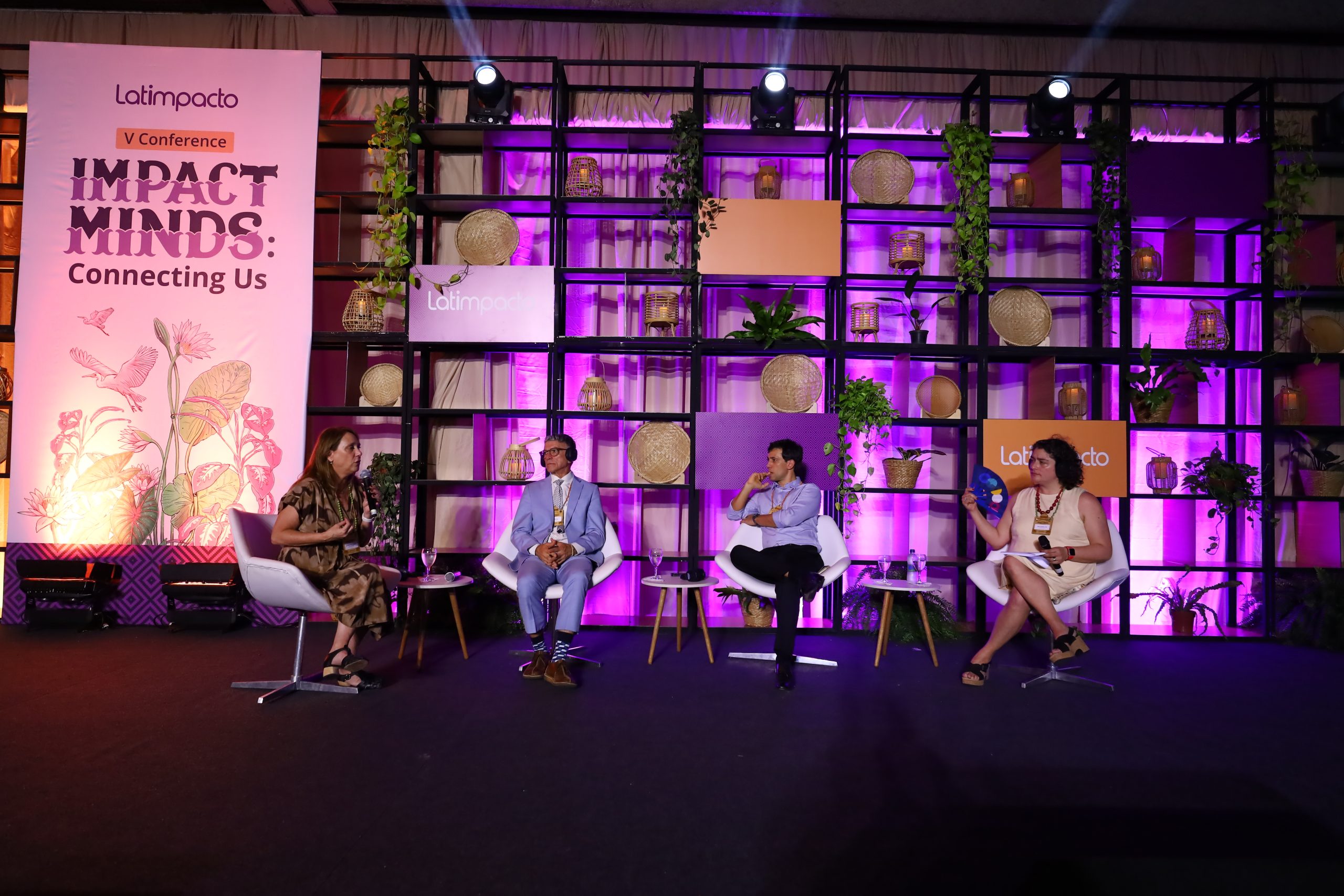
ImpactMinds 2026 debate explored the role of evidence, partnerships and regional collaboration in advancing literacy across Latin America.
How can successful initiatives be translated into public policies that ensure children develop literacy skills at the appropriate age and sustain these gains over time? This was a central question during a panel discussion at ImpactMinds 2026, Latimpacto’s annual conference, held in Manaus, Brazil.
The discussion brought together Karina Stocovaz, Instituto Natura’s Senior Manager for Spanish-Speaking Countries; Felipe Proto, Vice President of Education at Fundação Lemann; and Veveu Arruda, Executive Director of Associação Bem Comum. They explored strategies for expanding the reach of literacy policies and ensuring their long-term sustainability.
“Brazil’s experience helps us understand what is changing, even across different education systems. It shows us that progress is possible and gives us renewed momentum to advance literacy across Latin America. Results provide tangible evidence that can be understood beyond technical experts,” said Karina.
According to Karina, learning from these experiences does not mean applying the same approach everywhere. Strategies must be grounded in evidence, adapted to local contexts and designed to strengthen the capacity of the people and institutions responsible for implementing public policies.
“There is no one-size-fits-all solution. What matters is building alliances and partnerships,” she said.
Partnerships bring together resources and expertise
For Felipe Proto, collaboration allows organizations to pool financial resources, expertise and different perspectives to address literacy challenges.
“We set out to tackle a major challenge: literacy. To achieve this, philanthropy needed to find a different way of working. When we come together, we gain new perspectives.”
In Brazil, Associação Bem Comum, Fundação Lemann, Motriz, Nova Foundation and Instituto Natura work together to strengthen public literacy policies. Through this collaborative approach, civil society organizations support policy development and implementation while recognizing the central role of government.
“Those working on the ground are the ones who drive transformation. The third sector needs to understand its role, which is not to replace the State,” Veveu Arruda emphasized.
“We want governments to take ownership of the technical expertise we provide, develop their own public policies and take responsibility for funding them. That is what ensures long-term sustainability.”
Sharing experiences across countries
Differences between territories must also be taken into account when adapting successful experiences to new contexts.
“When we move from one state to another, we need to recognize that we are entering a different reality, with territories that have their own characteristics,” Veveu noted.
Across Latin America, Instituto Natura is part of the Regional Alliance for Literacy in Latin America, alongside Instituto Evidências Educativas, Fundación SURA and Fundación Arcor. The alliance promotes collaboration and knowledge exchange among countries.